We’ve all heard plenty of statistics about the devastating effects of sleep deprivation.
This post won’t be heavy on statistics, partly because stats can vary widely and I’m confident that what I’m presenting here supports my argument for more rest.
And also because statistics can be boring and might put you to sleep.
Oh, wait …
(If you’re reading this close to bedtime, feel free to stop and go to bed. No, seriously. Your sleep is more important than finishing this post right now.)
If you think I’m referring only to extreme sleep deprivation (pulling all-nighters) as “devastating,” understand that chronic sleep deprivation (even just a little too little on a routine basis) hampers proper functioning.
Over the years, studies have presented evidence of:
- Impaired physical performance. Athletes who sleep adequately have been shown to perform better than those who don’t, and the same holds true for all sorts of activities. Some studies have compared sleep deprivation to drunkenness above the legal limit for alcohol. Do you want to be on the same highway as a driver who’s had too much to drink … or too little sleep? Or, worse, do you want to be that driver?
- Impaired judgment (see previous item). Maybe you’re an accountant and mistype a number, and the IRS goes after your client, who sues you. Or maybe you’re a medical student and you ruin someone’s life – and your career. Maybe you make the wrong decision in a social setting and end up pregnant by a stranger – or with a sexually transmitted disease. (Extreme examples? You be the judge – but first get a good night’s sleep!)
- Crankiness (not that I would know anything about this 🙂 ). Relationships suffer: family, social, spiritual, workplace. A bad mood and impaired judgment can lead not only to lawsuits and diseases but an unhappy, dysfunctional household and other relationship problems.
- Overeating and weight gain. This can be the result of hormone imbalance and cravings – and I’m not talking carrots and celery sticks. Under-sleeping can lead to a rushed schedule and food on the run, and emotional factors that lead to overindulging or unhealthful eating; It can be from impaired judgment, the need for comfort and a host of other physiological factors.
- Immune system impairment and chronic illness. Even an excess of caffeine (coffee addiction, anyone?) can have unfavorable effects on your health. A friend’s loved one – a young man in his 20s – died because of prolonged excessive consumption of energy drinks, which included megadoses of caffeine. I know of a coffee variety called Jet Fuel; if you’re jet-lagged, choose sleep over caffeine.
- Depression. Before I came out on the other side of my depression – in the mid-1990s – I was working a 4-to-midnight shift; I’m a morning person, and I never felt rested in those years. Besides depressed, I was cranky, angry and critical about everything around me. Do you think I was a fun person to be around? (NOTE: When I worked through the depression, I still had the crazy work schedule, so I’m not blaming it solely on sleep deprivation, but it played a role.) Fortunately for Bruce, I had worked through my depression before we started dating. He knew me in those years, though, and he worried about me.
If you are depressed, reach out to me (or someone else you can trust) and we’ll talk about ways you can get help. I’m not a clinician, but I can point you to some resources. (My pastor’s wife and a good, in-depth book and companion workbook were my lifeline; for you it may involve medication and/or another type of solution.)
IF YOU ARE SUICIDAL, seek IMMEDIATE help from your physician, your pastor or someone else you can trust, visit the confidential National Suicide Prevention Lifeline or call the Lifeline at (800) 273-8255 (toll-free numbers are also available for Spanish speakers, hearing impaired, veterans and people in emotional distress related to “natural or human-caused disasters”).

SO … HERE’S WHERE THE RUBBER MEETS THE ROAD.
About 10 years ago, I started requiring a Sunday nap to get through the week. It was not long after I started The Worst Job I’ve Ever Had (I still have nightmares about it). I was stuck in that 60-hour-a-week job for 11 months, and I’m convinced it would have killed me if I hadn’t broken free.
I’ll tell you that story some other time (such as: in my last week there, I was diagnosed with a heart condition that eventually led to surgery). But today, I want you to think about YOUR story.
Ask yourself a few questions:
- Do you feel tired all the time, or much of the time?
- Do you get cranky, hangry (hungry/angry) or forgetful more than occasionally?
- Do you feel achy or breaky in your body … or your emotions?
- Do you drag your butt out of bed – and off to work or school – every day, and the feeling lasts all day, every day?
- Have you ever stopped to think about the amount of sleep that is optimal for your body and brain? It varies with age and other factors – small children need about 13 hours; teenagers about 9 ½ hours; and adults about 7-9 hours – so you need to figure it out if you don’t already know.
I’ve written about the importance of my nonnegotiable Sunday nap and my designation of Sunday as my Sabbath. For you it might be a different day of the week, but YOU NEED A SABBATH.
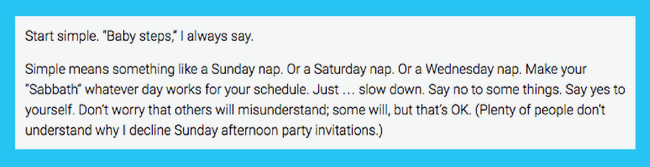 If your schedule is too busy for adequate rest, you need to figure out a way to change that. The past couple of weeks here at To Well With You, we’ve talked about margin (which includes saying NO to nonessentials) and decluttering (which includes the admonition to take a break from unproductive habits to clear some space for mental calmness). Today, it’s rest. (Next week: ways to get more and better sleep.)
Homework assignment: Ask yourself what ONE step you can take in the coming week to make a change in your sleep habits and satisfy your body and brain’s need for restorative rest. Post a comment here or on the Facebook page. Your idea just might spark a good habit for someone else.
Next week we’ll consider some ways we all can make changes, so come prepared to share your ideas and let us know how your week went. I’ll share our collection of ideas in the next post.
We’re all in this together, my friends. Now, go have a restful week. Zzzzzzzzzzz.
Resources:
- Psychologist Dr. Margaret Rutherford’s website and podcast. I met Dr. Margaret through the Arkansas Women Bloggers, and I was happy to know that she started a podcast, SelfWork, a few months ago. She addresses a variety of issues, including depression. (Need a calm, reassuring voice to settle you down? Dr. Margaret’s podcast is your ticket.)
- National Suicide Prevention Lifeline (as mentioned above).
- Inside Out: Real Change is Possible If You’re Willing to Start from the Inside Out by Dr. Larry Crabb. This is the book that was a life-changer for me in climbing out of depression.